

New Asylum Centre Plan Divides Hoogblokland Residents
Hoogblokland, 14 June 2026
A proposed asylum centre near Hoogblokland has sparked a heated debate, with 260 asylum seekers set to be housed if approved. Residents are split—some support the plan, while others criticise its location near a motorway and future construction. The Dutch government’s push for more asylum housing amid shortages adds urgency to the decision.
Location and Capacity: The Proposed Asylum Centre
The Central Agency for the Reception of Asylum Seekers (COA) has identified a site on Beemdweg in Hoogblokland, a village in the municipality of Molenlanden, for a new asylum seeker centre (AZC). The proposed facility is designed to accommodate 260 asylum seekers awaiting decisions from the Immigration and Naturalisation Service (IND) [1]. The location lies adjacent to the municipal boundary with Vijfheerenlanden, a factor that has become a focal point in local discussions [1]. Hoogblokland, with a population of approximately 1,500 residents [GPT], is situated in the Alblasserwaard region of South Holland, an area characterised by its rural landscape and proximity to major transport infrastructure.
Proximity to Infrastructure: A Point of Contention
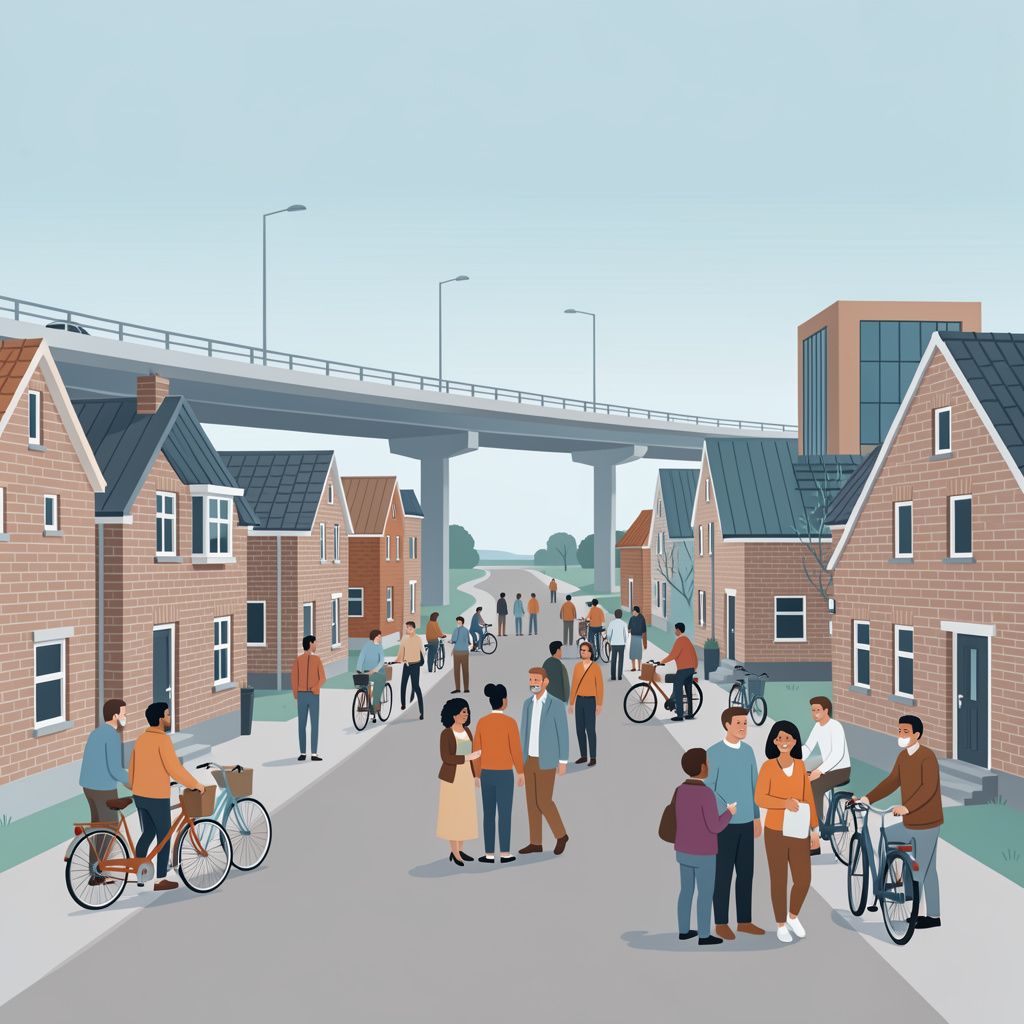
One of the most contentious aspects of the proposed site is its proximity to the A27 motorway, a major north-south route connecting Utrecht to Breda. The Beemdweg site lies within 500 metres of the motorway, which is currently undergoing a €1.2 billion expansion project to widen it from four to six lanes [GPT]. Residents have expressed concerns about increased noise pollution, traffic congestion, and the potential impact on local air quality, particularly given the site’s location near an industrial estate [1]. Tine van Dijke-de Boois, a local resident, criticised the choice of location, stating that it appears to be a case of “parking problems on the neighbour’s doorstep” and questioned whether more suitable sites could be found within Molenlanden itself [1].
Comparisons to Previous Disputes: A Pattern of Cross-Border Tensions
The debate in Hoogblokland is not an isolated incident. Residents and local commentators have drawn parallels with previous disputes over infrastructure and housing developments near municipal borders. Johan Tieleman, another resident, likened the situation to Germany’s approach to wind turbine placement, where turbines are often sited as close as possible to Dutch borders [1]. He referenced a prior controversy in which Molenlanden proposed placing large wind turbines near the boundary with Papendrecht, a plan that was ultimately abandoned due to opposition [1]. Similarly, Bas Leeuwis, a contributor to the discussion, pointed to a housing development in Sliedrecht that proceeded despite objections from neighbouring Hardinxveld-Giessendam, suggesting a broader pattern of “not in my backyard” (NIMBY) politics influencing cross-border planning decisions [1].
Local Reactions: Support and Opposition
Reactions to the proposed AZC have been sharply divided. Supporters of the plan argue that the site’s location, approximately 5 kilometres from the nearest urban centre (Meerkerk), minimises disruption to local communities [1]. Ton van Barneveld, a resident, noted that the site is separated from Meerkerk by an industrial estate, which he believes provides a sufficient buffer [1]. However, opponents, such as Karen de Groot, have described the plan as “absolutely unacceptable,” arguing that it unfairly burdens the neighbouring municipality with what they perceive as “nuisance” [1]. Yannick Schrijvers, another resident, framed the debate in terms of limited options, stating that if Molenlanden does not propose a site, the provincial government may impose one, potentially leading to a less favourable outcome [1].
Broader Context: National Asylum Housing Shortages
The proposal in Hoogblokland is part of a nationwide effort to address severe shortages in asylum seeker housing. As of June 2026, the COA manages 72 reception centres across the Netherlands, with a total capacity of approximately 35,000 places [GPT]. However, the number of asylum seekers in the Netherlands has risen sharply in recent years, driven by conflicts in Ukraine, Syria, and other regions. In 2025, the IND received over 50,000 asylum applications, a 30% increase from 2024 [29.998][2]. This surge has led to overcrowding in existing centres, with some facilities operating at 120% of their intended capacity [GPT]. The Dutch government has pledged to create an additional 10,000 reception places by the end of 2026, but progress has been slow due to local resistance and planning delays [GPT].
Timeline and Next Steps
As of 14 June 2026, the proposal for the Hoogblokland AZC remains under consideration, with no final decision yet made [1]. The municipality of Molenlanden is expected to conduct a public consultation in the coming weeks, during which residents will have the opportunity to submit formal objections or expressions of support [1]. Following this consultation, the municipal council will vote on whether to approve the plan. If approved, the COA will proceed with detailed planning and environmental impact assessments, a process that typically takes 12-18 months [GPT]. Construction could begin in early 2028, with the centre potentially opening by mid-2029, assuming no legal challenges are mounted [GPT]. However, given the contentious nature of the proposal, legal action from residents or neighbouring municipalities cannot be ruled out [alert! ‘No formal objections have been filed as of 14 June 2026, but historical precedents suggest potential delays’].