

Hate Crime Surge: The Hague Mosque Vandalised with Nazi Symbols and Slurs
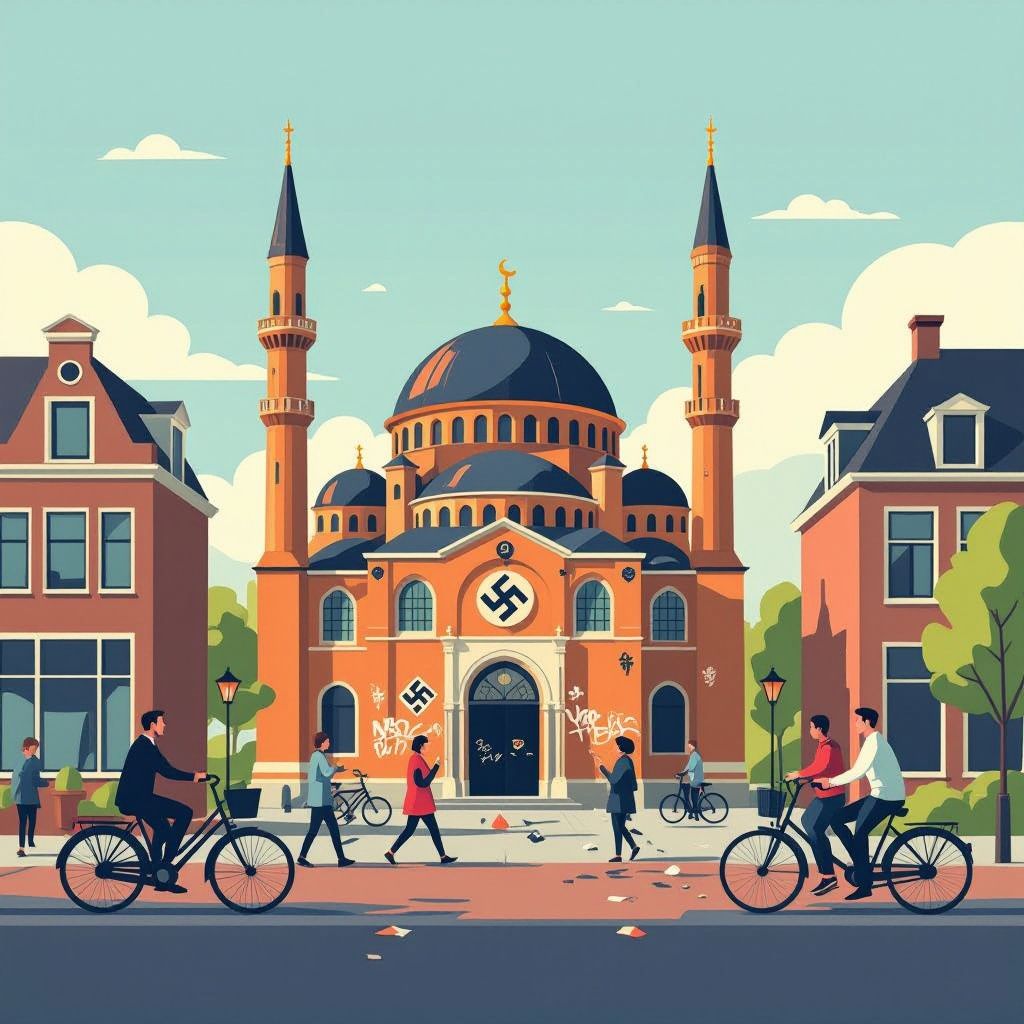
The Hague, 16 June 2026
A mosque in The Hague was defaced with swastikas and hate messages, including ‘Heil Hitler’, marking the latest in nearly 300 anti-Muslim incidents since 2015. This brazen act has sparked outrage and fear among local communities, with leaders demanding urgent action against rising Islamophobia in the Netherlands.
The Incident: A Mosque Defaced with Nazi Symbols
On Sunday, 14 June 2026, the Noeroel Islam Mosque in The Hague was vandalised with swastikas and hateful graffiti, including the phrases ‘Heil Hitler’ and ‘fuck Islam’ [1][2]. The mosque and local police confirmed the incident, which occurred overnight, leaving the building’s exterior marred with symbols synonymous with Nazi Germany and anti-Muslim rhetoric. Mosque chairman Muhiyuddin Hansildaar described the act as a direct confrontation with ‘expressions of hate and intolerance’ towards worshippers and the Islamic community [2]. The police have launched an investigation, though it remains unclear whether a formal complaint has been filed as of Tuesday, 16 June 2026 [1].
A Pattern of Hate: Nearly 300 Incidents Since 2015
This latest act of vandalism is not an isolated event. The Islamitische Stichting Nederland (ISN), an umbrella organisation for Turkish mosques in the Netherlands, reports that nearly 300 incidents of threats, vandalism, and arson against mosques have been recorded since 2015 [1][2]. These incidents range from graffiti and broken windows to more severe cases, such as the September 2025 threats, when multiple mosques in The Hague, Rotterdam, Eindhoven, and Arnhem received blood-stained letters [1]. The ISN has warned of a ‘serious increase’ in Islamophobic intimidation, linking the trend to broader societal polarisation [2].
Political Fallout: Leaders React and Demand Action
The vandalism has prompted swift condemnation from local and national leaders. Jan van Zanen, the mayor of The Hague, expressed his dismay, stating that the city ‘stands with its mosques and Muslim community’ in the face of such hate [2]. Meanwhile, Tweede Kamer (Dutch parliament) member Ismail el Abassi of the Denk party announced plans to request an urgent parliamentary debate on the rising tide of mosque attacks [2]. El Abassi did not mince words, labelling the attacks as ‘barbaric’ and implicating certain political figures in fuelling anti-Muslim sentiment. He specifically cited Geert Wilders’ 2022 social media post, ‘F*ck Allah’, made in the aftermath of a World Cup match between Morocco and Brazil, as an example of inflammatory rhetoric [2]. El Abassi warned that such incidents could provoke a backlash from within the Muslim community, further escalating tensions [2].
The Broader Context: Islamophobia and Political Rhetoric
The vandalism at the Noeroel Islam Mosque occurs against a backdrop of rising anti-Muslim sentiment in the Netherlands and across Europe. Far-right groups and political figures have increasingly targeted Muslim communities, framing them as a threat to national identity and security [GPT]. In the Netherlands, this rhetoric has been amplified by parties such as the Partij voor de Vrijheid (PVV), led by Geert Wilders, whose 2023 election campaign included promises to ‘de-Islamise’ the country [GPT]. While Wilders’ party did not secure a majority, its influence has contributed to a normalisation of anti-Muslim discourse in political and public spheres [GPT]. Social media has also played a role in spreading hate, with platforms like Instagram hosting content that further polarises communities. A recent post by the account ‘groenrechts_nl’ questioned whether supporters of the Moroccan national football team would ‘demolish things’ if they won or lost, using derogatory language and hashtags such as ‘#marokko’ and ‘#wk’ (World Cup) [3]. The post, which garnered over 200 likes, reflects the casual racism that often accompanies discussions about Muslim and migrant communities in the Netherlands [3].
What Happens Next: Reporting Hate Crimes and Seeking Support
In the wake of the incident, Dutch authorities have urged victims and witnesses of hate crimes to come forward. The police are treating the vandalism as a serious offence, and investigations are ongoing [1]. Individuals who experience or witness discrimination can report incidents to the police or contact organisations such as the antidiscriminatiebureau (anti-discrimination bureau), which provides support and legal assistance [1]. The Dutch government has also reiterated its condemnation of such acts, though critics argue that stronger measures are needed to address the root causes of Islamophobia and hate crimes [2]. For asylum seekers and refugees, the incident underscores the importance of community solidarity and access to resources. Organisations such as the ISN and local advocacy groups offer platforms for reporting incidents and seeking support, though fear of reprisals or deportation may deter some from coming forward [alert! ‘No direct data on asylum seeker reporting behaviour in this context’][1][2].