

Riots Erupt in Dutch Town as Far-Right Groups Hijack Protest Against Asylum Seeker Shelter
Wijk bij Duurstede, 13 June 2026
Violent clashes broke out in Wijk bij Duurstede on 11–12 June 2026, when radical far-right groups infiltrated a local protest, smashing town hall windows and attacking police — yet local volunteers simultaneously prepared a warm welcome for the arriving asylum seekers.
A Town Divided: The Night Violence Took Hold
What began as a demonstration in Wijk bij Duurstede — a modest town in the Dutch province of Utrecht — descended into serious disorder on the evening of 11 June 2026. According to the NOS, a crowd that had initially numbered around 30 people swelled to approximately 60 as the night progressed, with members of radical far-right ‘defend groups’, including Defend Netherlands, identified among the rioters [2]. The police spokesperson described the atmosphere as ‘erg grimmig’ — extremely grim [2]. By the time the violence peaked, rioters had knocked over three security cameras, smashed windows in the town hall, hurled fireworks inside the building, and pelted police vehicles with projectiles [2][4]. A noodbevel — an emergency order — was issued for the area surrounding the town hall, with at least 20 police cars responding with sirens and lights [4]. Around midnight, as the unrest spilled from 11 into 12 June 2026, the police force on the ground escalated to more than 80 officers, supported by dog units, mounted police, a helicopter, and the riot police (ME) [2]. Seven individuals were arrested and remained in custody on the morning of 12 June 2026 [2][3].
The Trigger: An Emergency Shelter at Sportpark Mariënhoeve
The protests centre on a municipal decision to open an emergency shelter (noodopvang) for between 50 and 75 asylum seekers at sportpark Mariënhoeve from approximately mid-June 2026 — with an expected start date of around 15 June 2026 [2][7]. The shelter is planned for a minimum duration of two months [7]. The decision was not made at the municipality’s own initiative but at the direct request of the national government: as RTV Utrecht reported, the relevant minister called upon Wijk bij Duurstede because there are insufficient reception places elsewhere in the Netherlands, and without emergency shelters, asylum seekers risk sleeping on the streets [7]. This reflects the nationwide pressure on the Central Agency for the Reception of Asylum Seekers (COA), whose regular reception centres (AZCs) are operating at capacity [GPT]. The municipality had been facing near-daily protests near the town hall in the weeks prior to the violence [4].
Not the First Time: A Pattern of Escalating Unrest
The riots of 11–12 June 2026 were not an isolated incident — they were, in fact, the second violent episode within a single week in Wijk bij Duurstede. On 5 June 2026, fireworks were thrown and damage was inflicted on the town hall during a separate protest [2]. Acting mayor Petra Doornenbal did not mince her words in response to the second incident: ‘Zelfs als je denkt dat de bodem is bereikt, blijkt de rel-avond van vrijdag 5 juni niet de ondergrens te zijn geweest. Ik heb hier echt geen woorden voor’ — ‘Even when you think the bottom has been reached, the riot evening of Friday 5 June turned out not to have been the lowest point. I truly have no words for this’ [2]. The pattern extends beyond Wijk bij Duurstede. On 3 May 2026, a protest against an emergency shelter in IJsselstein resulted in a police officer being injured by fireworks and damage to the town hall and a theatre [2]. On 13 May 2026, protests against a planned shelter in Loosdrecht led to four arrests and the deployment of a water cannon [2]. The municipality’s suspicion, expressed on 12 June 2026, was that a number of those involved in the Wijk bij Duurstede protests had travelled from outside the town to participate [1].
An Earlier Chapter: Local History Adds Complexity
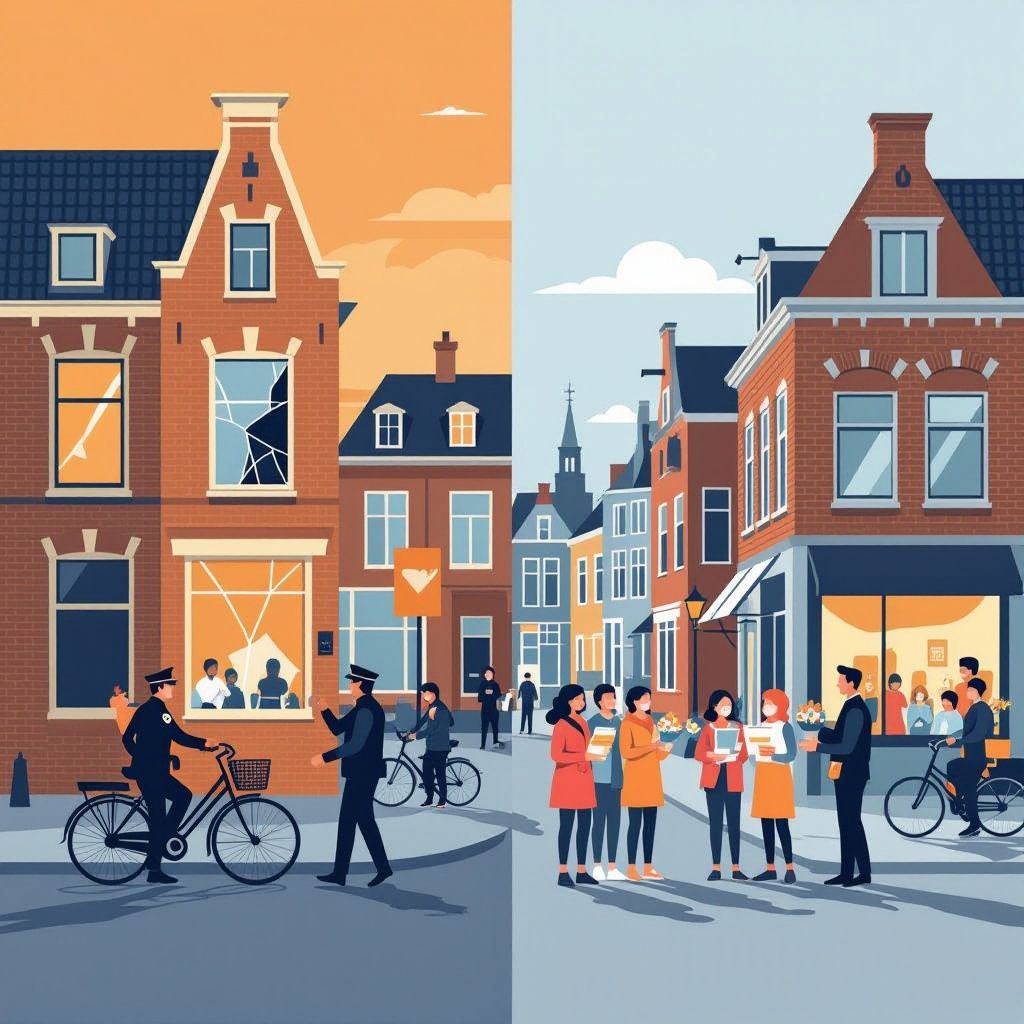
Wijk bij Duurstede is not without prior experience of hosting asylum seekers. According to RTV Utrecht, the town previously accommodated asylum seekers in its sports hall on an earlier occasion, and that episode generated local tension — including incidents of shoplifting and antisocial behaviour from a small number of residents at the facility [7]. That history has clearly not been forgotten by a segment of local residents, with one demonstrator quoted as saying: ‘Het wordt weer precies hetzelfde gezeik als de vorige keer. We willen ze hier gewoon niet’ — ‘It will be exactly the same nonsense as last time. We simply do not want them here’ [7]. However, the picture on the ground in June 2026 is far from uniformly hostile. As AD journalist Wim van Amerongen reported on 13 June 2026, a group of local volunteers — some of whom were also active in 2022 supporting asylum seekers during a previous crisis shelter — has mobilised once more to provide a warm welcome to the new arrivals, specifically aiming to show vulnerable people that they are welcome [1]. The contrast between the rioters and the volunteers illustrates the genuine division of public opinion within the town itself [1][2].
Democracy Under Assault: The Mayor Responds
Acting mayor Petra Doornenbal’s reaction to the events of 11–12 June 2026 was one of undisguised alarm at both the physical and democratic implications of the violence. ‘Het hart van onze democratie is geraakt door de aanval op het gemeentehuis’ — ‘The heart of our democracy has been struck by the attack on the town hall’ — she stated, adding that residents living near the town hall had been made to feel unsafe in their own homes, with their immediate surroundings transformed into what she described as a threatening and ominous place [2][4]. Nevertheless, Doornenbal struck a defiant note: ‘Maar we laten ons niet terroriseren en intimideren door geweld en gaan vandaag beginnen met opruimen en herstellen’ — ‘But we will not be terrorised and intimidated by violence, and today we begin clearing up and repairing’ [2]. Repair works on the town hall were scheduled to begin on 12 June 2026 [alert! ‘Source states repairs were planned to start on 12 June 2026 but does not confirm whether they commenced as scheduled’]. For the asylum seekers themselves — who are due to be housed at Mariënhoeve from around 15 June 2026 — the COA has indicated it will inform those being moved to the location directly [GPT]. Meanwhile, Dutch law is unambiguous: violence against asylum seekers or their accommodation is illegal [GPT], and the seven individuals arrested in the early hours of 12 June 2026 remained in custody as of that morning [2][3].